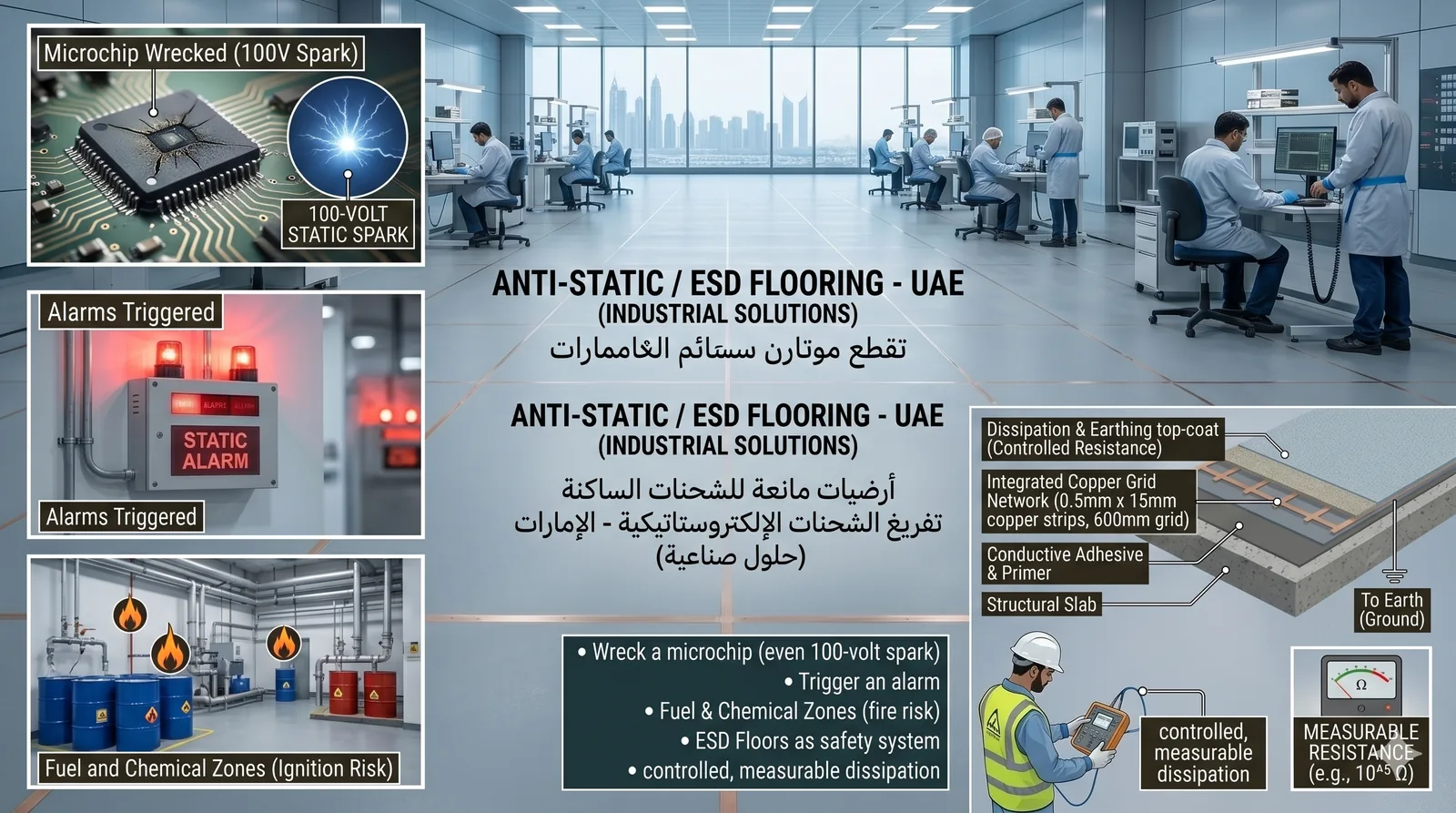
Static discharge is invisible. The cost of it isn't. We've seen Gulf data centres lose six figures on a server-board failure traced to a 1 cm static spark from a flat-shoe technician.
Conductive vs dissipative — which do you need?
| Surface resistivity | Class | Use case |
|---|---|---|
| 10⁴ – 10⁶ Ω | Conductive | Data centres, server halls, ammo handling |
| 10⁶ – 10⁹ Ω | Dissipative | Electronics assembly, OT, pharma cleanroom |
| 10⁹ – 10¹² Ω | Anti-static (insulating) | General office, light electronics |
Most data-centre clients we work with want 10⁴–10⁶ Ω conductive. Most pharma and OT clients want 10⁶–10⁹ Ω dissipative — the gentler decay rate is kinder to sensitive equipment.
The system layers
- Concrete substrate, diamond ground to CSP-3
- Conductive primer with carbon-black additive
- Copper grounding strips at 6 m centres, bonded to building earth
- 2–3 mm self-level conductive epoxy with carbon-fibre filler
- Test surface resistivity at 100+ points per IEC 61340-2-3
- Issue stamped test report at hand-over
Where Gulf clients trip up
Treating ESD as just a "type of paint"
It's a system. Without the grounding strips and the primer chemistry, the coating doesn't dissipate — it just sits insulating.
Skipping the test report
Insurers and certification bodies (UL, BICSI for data centres) require documented resistivity testing. We always test before invoicing.
Mixing zones without isolation
If your server hall is 10⁶ Ω but the corridor outside is 10¹² Ω, technicians charge up walking in. Run the conductive system 1 m past the door threshold and ground it.
Where it works in the Gulf
- UAE telecoms data centres (Tier III & IV)
- Qatar Defence avionics workshops
- Dubai Silicon Oasis EMS plants
- Pharma fill-finish lines in DuBiotech and Ras Bufontas
- OT and MRI rooms in DHA, MOH UAE, MOPH Qatar facilities
Need an ESD floor with proper test reports? Send us the room dimensions — we'll come measure resistivity of the existing slab as the first step.