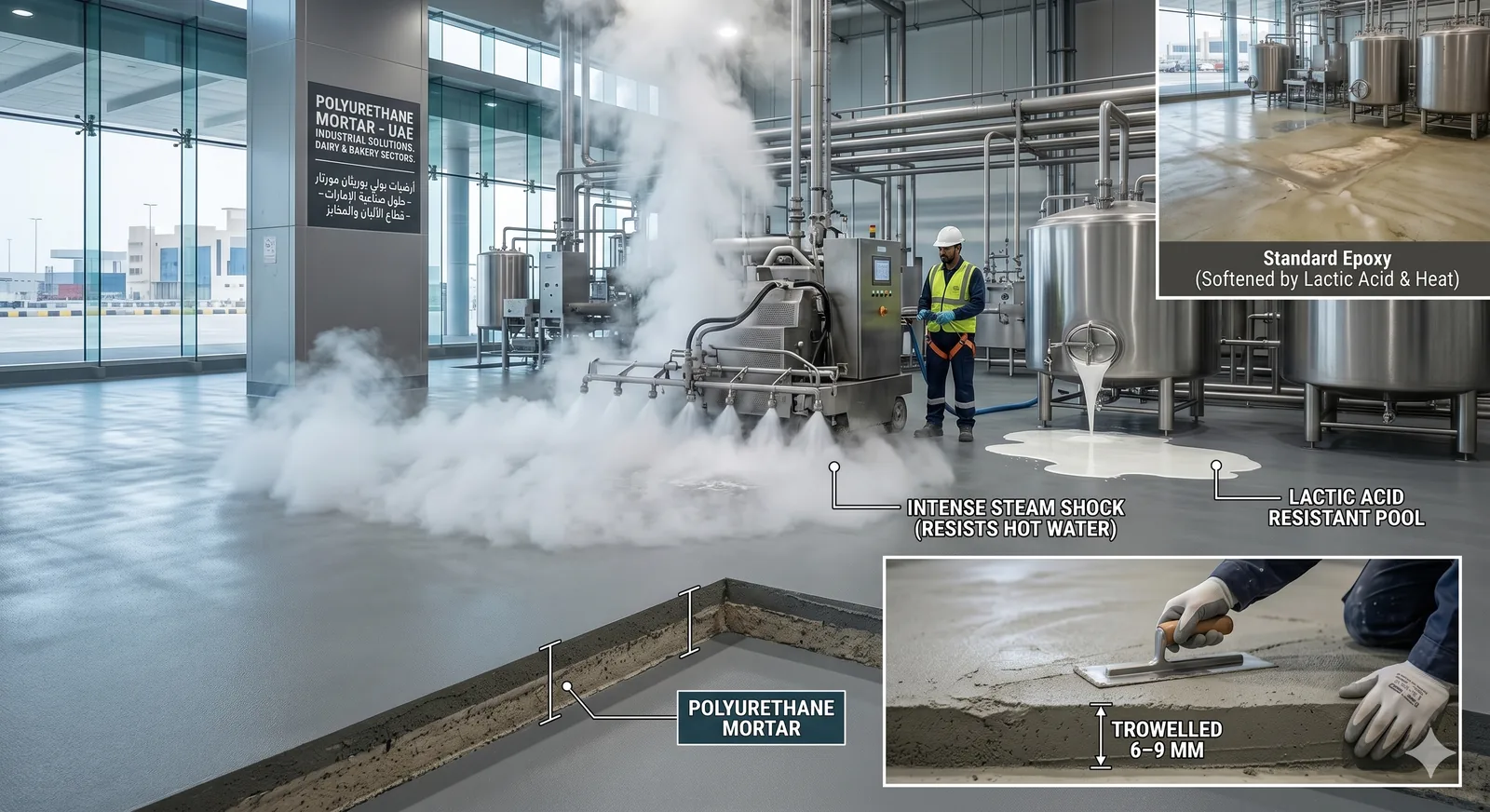
Two questions decide whether you should specify an epoxy floor or a polyurethane (PU) mortar floor for your Gulf facility: how hot will it get, and what chemicals will it see?
The five-question test
- Daily wash-down above 60°C? → PU mortar.
- Hot oil, fat or sugar spillage? → PU mortar.
- Lactic, acetic or phosphoric acid? → PU mortar.
- Freeze-thaw cycling (cold rooms, freezers)? → PU mortar (or PMMA fast-cure).
- Mirror-gloss decorative finish? → Epoxy.
Anything outside those five answers — warehouses, garages, showrooms, dry production, retail — is almost always epoxy. PU costs roughly 30–60% more per square metre, so don't pay for it unless one of the five conditions is in play.
Where it matters most in the Gulf
Food & beverage processing
A Gulf bakery floor sees flour dust, hot oil, and daily steam wash. Epoxy will craze and lift in 18 months. PU mortar at 6–9 mm is the only honest spec.
Cold rooms
Below 0°C, epoxy becomes brittle. Repeat thaw-and-freeze cycles fracture the resin within 2–3 years. PU and PMMA flex through the cycle.
Warehouses (almost always)
3PL distribution centres in JAFZA, Dubai Industrial City, Industrial Area Doha — plain forklift load on dry concrete is the textbook epoxy use case. Don't over-spec.
The fastest way to waste money on a Gulf resin floor is to over-specify. The fastest way to fail one is to under-specify the chemistry.
Cost comparison (indicative)
| System | Thickness | QAR / m² | AED / m² |
|---|---|---|---|
| Self-level epoxy | 3 mm | 130–180 | 120–170 |
| Heavy-duty epoxy screed | 5–6 mm | 200–250 | 185–230 |
| PU mortar | 6 mm | 240–310 | 220–290 |
| PMMA fast-cure | 4 mm | 320–410 | 295–380 |
Bottom line
Run the five-question test. If you answered "no" to all five, epoxy will serve you for 8–15 years and save you 30–60%. If you answered "yes" to even one, specify PU mortar and budget accordingly. Send us a photo of your existing floor and we'll tell you which way the answer points within an hour.